
I’ve been playing nature games for stress relief more deliberately recently. Wingspan, Eastshade, and stretches of Breath of the Wild where I’m not really doing quests so much as wandering around looking at trees and water. And I’ve been wondering whether it’s doing the thing I’m hoping it’s doing, giving me that nature fix to reset my factory settings and calm me down. Or whether I’m just procrastinating from going outside.

The reason I care about this is probably worth explaining. Being out in nature is one of the most reliable tools I have for my mental health. For anyone who lives with depression and anxiety, you’ll know that “reliable” is not a word you throw around lightly. But for me, it genuinely is. It’s something I come back to every day, and it works in a way that’s hard to articulate but impossible to ignore.
So when I started noticing that certain games were producing something similar, I wanted to know if there was anything behind it, or whether I was just rationalising an excuse to stay on the sofa.
Turns out: there’s research. Quite a lot of it, actually.
Do Nature Games Actually Reduce Stress?
The short version is this. Studies comparing virtual nature to real nature have found that while real nature still has a slight edge, the gap is smaller than you might expect. One meta-analysis put it plainly: across multiple studies measuring anxiety, mood, and stress, researchers found no significant difference between VR nature environments and flat-screen nature content. The medium, it seems, matters less than what’s in it.
What’s doing the work, according to something called Attention Restoration Theory, is that nature, real or simulated, supports mental health by restoring attention through effortless engagement. It gives your brain something absorbing to do that isn’t demanding. It’s a break from cognitive load, not an addition to it. Which, if you’ve ever tried to “relax” by scrolling through your phone and felt more strung out twenty minutes later, makes a lot of sense.
What the Research Actually Found: The Flower Study
One of the most striking studies on nature games and stress relief used a casual game called Flower where you guide petals through meadows, and measured what happened after twenty minutes of play. The results were across the board: statistically significant reductions in self-reported psychological stress, heart rate, systolic blood pressure, and diastolic blood pressure. All four markers.

The researchers were comparing it directly to a mindfulness meditation session, and across every single physiological measure, the two interventions performed similarly. The game held its own against meditation.
Cosy Games, Mental Health, and the Flow State
I want to be careful not to oversell this, because the wellness-through-gaming conversation has a tendency to go very corporate very quickly. Nature games are not a substitute for actual healthcare, or for going outside, or for addressing whatever is making you stressed in the first place. The research is clear that real nature still does more. Fresh air is, of course, still better for you.
But I think what’s interesting here isn’t that games have been proven to be medicine. It’s that something we do intuitively, reaching for something green when we need to decompress, turns out to have a legitimate neurological basis.
There’s a concept that keeps coming up in the research on video games and anxiety, borrowed from psychology, called the flow state. It’s the thing that happens when you’re absorbed enough in an activity that the background noise of anxiety goes quiet because your attention is elsewhere. Games are, researchers note, unusually good at inducing it, because they provide clear goals, immediate feedback, and just enough challenge to keep you present. Nature games, being generally unhurried and exploratory, seem particularly well suited to this.
Do Nature Games Have to Be Relaxing to Be Restorative?
A good example of this (and I’ll admit some bias here because these are my all-time favourite games) is the Ori series. Ori and the Blind Forest and Ori and the Will of the Wisps are not relaxing by any conventional measure. They’re precise, demanding platformers that will make you cry at the story and quite possibly swear at the difficulty. They are not games you pick up to wind down.
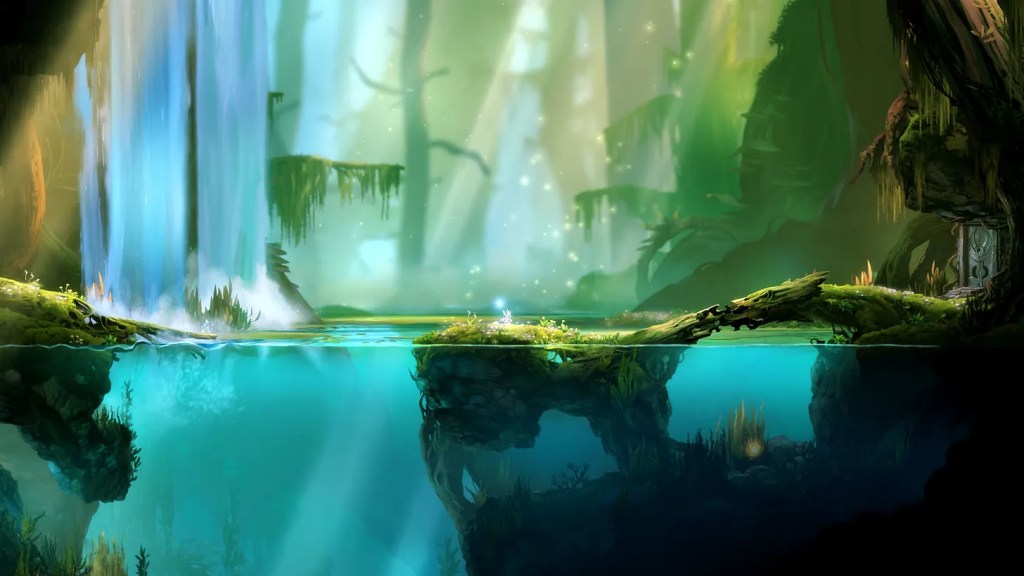
And yet. The environments are among the most breathtaking in gaming — luminous forests, cascading water, light filtering through ancient trees in a way that frankly puts most real-world scenery to shame. And the flow state they induce in me is total. Which suggests that the restorative effect of nature in games might be less about the pace of the gameplay and more about the depth of the immersion.
Freedom, Autonomy, and Being Over Forty
The study I found most interesting looked specifically at open-world games. It found that players reported a sense of freedom and autonomy that was directly tied to reduced stress levels, not just as a side effect but as a mechanism. The exploration itself was the thing. Moving through a world at your own pace, with no one timing you or ranking you or requiring you to perform.
I’ve been thinking about why that is so relevant for gamers over forty. Partly it’s that you’ve accumulated enough actual responsibilities that genuine unstructured time becomes rare. Partly it’s that leisure, for women especially, so often comes with invisible obligations attached to be productive, to be improving, to be doing something that will benefit someone else eventually.

The research calls the stress reduction real. I’d call it something else too, though I’m not sure I have the academic vocabulary for it yet. Maybe just: approval. To be somewhere beautiful for a while. To let your nervous system remember what it feels like when nothing needs fixing.
The forest really doesn’t care whether you’re doing it right. That might be exactly the point.
Can Nature Games Relieve Stress?
The evidence suggests yes, and meaningfully so. Virtual nature appears to engage the same psychological mechanisms as real nature, and nature-based games in particular combine that with the additional benefits of flow state and a genuine sense of freedom. They won’t replace a walk in the woods, and they’re not a treatment for anything. But as a tool for stress relief and mental restoration? The science says they’re doing something real.
So next time someone raises an eyebrow at you wandering through a digital forest instead of a real one, you can tell them the research is on your side.

What nature-based games have you been playing lately? I’d love to know what’s in your rotation — drop it in the comments.

Leave a Reply